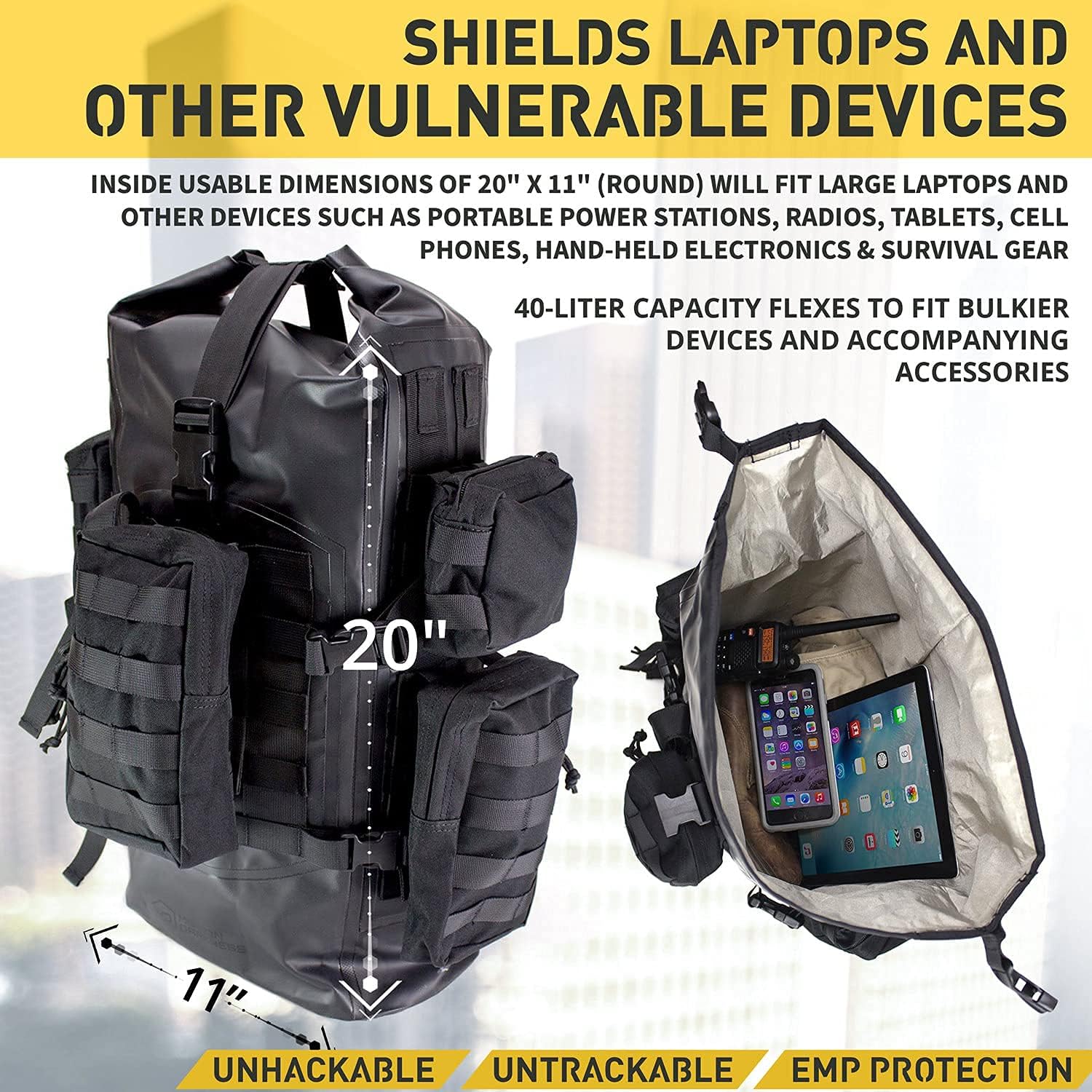
A Faraday bag is essentially a portable signal cage for your electronics. The bag is lined with a metallic mesh or laminated foil that blocks electromagnetic signals — meaning Wi-Fi, cellular, Bluetooth, and GPS can’t get in or out while your device is inside. That matters when you want to prevent remote tracking, protect a car key fob from relay theft, or ensure a device is forensically isolated. Most Faraday bags on the market work reasonably well indoors, sitting on a desk. The harder question is what happens when you take one hiking in a rainstorm, stuff it in a sweaty pack for three days, or use it in a marine environment. That’s what this guide is about: understanding which Faraday bags are built to hold up outdoors and in travel conditions — and what to look for in the specs before you buy.
| EDITOR'S PICK[Mission Darkness Dry Shield Far…](https://www.amazon.com/dp/B081D9RV9P?tag=greenflower20-20) | Mid-tier[Silent Pocket SLNT Waterproof F…](https://www.amazon.com/dp/B01KB51C6E?tag=greenflower20-20) | Budget pick[Faraday Bags EMP Proof](https://www.amazon.com/dp/B0DS5NZFBZ?tag=greenflower20-20) | |
|---|---|---|---|
| Capacity | 40L | 5L | — |
| MOLLE Webbing | ✓ | — | — |
| Fireproof | — | — | ✓ |
| Handle | — | — | ✓ |
| Removable Packs | ✓ | — | — |
| Price | $297.00 | $69.95 | $26.99 |
| See on Amazon → | See on Amazon → | See on Amazon → |
Why Weatherproofing and Signal Blocking Are Both Harder Than They Look
These two properties — water resistance and RF (radio frequency) shielding — pull in opposite directions during manufacturing. A truly waterproof outer shell typically requires sealed seams, which means heat-welded or taped edges. But Faraday liners depend on a continuous, electrically conductive layer that is uniform and unbroken. Every seam, zipper, fold, or closure mechanism is a potential gap in the shielding — and water-resistant treatments, adhesives, and zipper tape can all degrade the conductivity of that inner layer if applied carelessly.
This isn’t just an engineering curiosity. The Mission Darkness product datasheet for their Dry Shield series explicitly addresses this, noting that the roll-top dry-bag closure was chosen specifically to eliminate zipper gaps that would otherwise compromise RF attenuation at higher frequencies. Zippers — even double-layer RF-shielded zippers — are consistently the weakest point in attenuation performance per published spec comparisons.
The second challenge is mechanical durability. Conductive fabrics used in Faraday liners — typically a woven silver, nickel-copper, or aluminum-polyester laminate — can crack or delaminate with repeated folding, compression in a pack, or exposure to UV radiation over time. Less EMF Inc.’s product specification documentation notes that silver-based fabrics, while highly conductive, are more vulnerable to abrasion and flex cracking than nickel-copper composites. For outdoor use, that’s a meaningful tradeoff.
What the Specs Actually Tell You (and What to Ask For)
Before buying any Faraday bag for outdoor use, you want answers to three questions from the manufacturer:
1. What is the published dB attenuation, and at which frequencies?
Attenuation is measured in decibels (dB) — it quantifies how much the bag reduces signal strength. A higher number means stronger blocking. As a reference point, 20 dB means the signal is reduced to 10% of its original strength; 60 dB reduces it to 0.1%; 80 dB reduces it to 0.01%. Most credible consumer Faraday bags publish attenuation in the 50–80 dB range across cellular frequencies (700 MHz–2.7 GHz). GPS (1.575 GHz) and Wi-Fi (2.4 GHz / 5 GHz) should also be listed separately if the manufacturer is being thorough.
2. Has the attenuation been independently tested, or is it self-reported?
This is the site’s core transparency standard. Self-reported specs from a manufacturer’s internal testing are better than nothing, but independent lab verification — typically performed to ASTM D4935 (shielding effectiveness of flat materials) or MIL-STD-461 protocols — is the benchmark. DefenderShield’s published lab reports reference independent third-party testing methodology and include frequency-by-frequency attenuation curves, which is the gold standard for consumer-facing documentation. If a product page shows only a single “up to X dB” claim with no frequency range and no lab name, treat that number skeptically.
3. What is the IPX or waterproofing rating, and does it apply to the seams and closure?
IPX ratings (part of the IEC 60529 standard) describe how a product handles water exposure. IPX4 means splash-resistant from any direction. IPX7 means submersion to 1 meter for 30 minutes. For a travel Faraday bag going into an outdoor pack, IPX4 is a practical minimum; IPX6 (powerful water jets) is better for serious field use. Critically — and this is where marketing language often misleads — the IPX rating must apply to the fully assembled bag including its closure system. A waterproof body with a non-waterproof zipper is not a waterproof bag in practice.
By the Numbers
| Feature | Baseline (indoor/EDC use) | Outdoor/Travel Standard | Field/Forensic Standard |
|---|---|---|---|
| RF Attenuation (cellular) | 50–60 dB | 60–75 dB | 75–90 dB |
| Water Rating | None / splash | IPX4–IPX6 | IPX6–IPX7 |
| Closure Type | Zipper | Double-fold roll-top or RF-sealed zipper | Double-fold roll-top + secondary RF flap |
| Independent Lab Cert | Optional | Preferred | Required |
The Main Product Tiers Worth Knowing
Mission Darkness Dry Shield Faraday Bag
Mission Darkness is among the most referenced brands in forensic and law-enforcement Faraday applications, and their Dry Shield line is specifically engineered for outdoor environments. The roll-top closure is borrowed from dry-bag design and avoids the zipper gap problem entirely. Per the Mission Darkness TitanRF datasheet, the Dry Shield series uses their TitanRF fabric, which is independently tested and published at 75–85 dB attenuation across 10 kHz–10 GHz — a notably wide frequency range that covers GPS, cellular, and Wi-Fi bands.
Who this is for: Field investigators, security professionals, and serious travelers who need verifiable attenuation with water resistance they can trust in rain or high-humidity environments. The price range runs approximately $60–$120 depending on size.
The tradeoff to name explicitly: The roll-top closure, while excellent for signal integrity and water resistance, is slower to access than a zipper. If you’re pulling a key fob in and out dozens of times per day, that friction adds up.
Silent Pocket Faraday Sleeve (Waterproof Series)
Silent Pocket publishes attenuation specs and offers a waterproof-rated variant in their lineup. Across aggregated reviewer commentary, the consistent note is that the form factor is well-suited to passports and travel documents alongside a phone — making it popular with the frequent-flyer segment. Published specs per their product documentation cite 110 dB attenuation at 800 MHz, though independent verification documentation is less prominently featured than Mission Darkness’s lab reports.
Who this is for: Everyday travel buyers who want a slim, well-designed bag that handles light weather and provides strong signal isolation for phone and RFID cards simultaneously.
The tradeoff: The “110 dB” headline figure is a manufacturer-reported number; independent frequency-curve data isn’t as readily available as forensic-grade products. For general travel privacy, that’s acceptable. For chain-of-custody device isolation, it isn’t.
OffGrid Faraday Bags (EMP-Shield Series)
OffGrid positions their products around dual-threat protection: RF shielding plus EMP (electromagnetic pulse) hardening. Their datasheet claims 60–80 dB across cellular and GPS frequencies in a water-resistant outer shell. Owners on long-run reviews consistently flag the dual-layer construction — an inner RF liner plus an outer Faraday pouch — as a distinguishing feature that helps maintain signal integrity even when the outer pouch takes physical abuse.
Who this is for: Preparedness-focused buyers, overlanders, and outdoor enthusiasts who want the EMP angle in addition to standard RF blocking. Pricing is typically $40–$80 for phone/tablet sizes.
The tradeoff: EMP hardening beyond a certain threshold requires a rigid Faraday enclosure for truly sensitive electronics (per NIST SP 800-101 Rev. 1’s discussion of device isolation standards). A soft-sided pouch is better than nothing for EMP, but it’s not equivalent to a metal ammo can or rigid enclosure. Don’t let the EMP marketing claim do more work than it should.
The Outdoor Durability Factors That Don’t Appear in RF Specs
A bag can pass its RF attenuation test on the day it ships and then fail six months into field use. Here’s what degrades performance over time in outdoor conditions, based on material science documentation from Less EMF Inc. and published building-biology guidance from lessemf.com:
- UV exposure breaks down polyurethane coatings and can cause delamination of the foil-fabric laminate in cheaper bags. Look for UV-stabilized outer shells if the bag will spend time exposed to sunlight.
- Salt air and sweat are corrosive to silver-based conductive fabrics. Nickel-copper composites resist corrosion better in marine environments. If your use case is coastal or high-humidity, ask the manufacturer specifically about corrosion resistance.
- Compression cycling — repeated packing and unpacking under load — can crack aluminum foil liners. TitanRF-type woven metallic fabrics handle flex better than foil laminates.
- Washing and cleaning can strip conductive coatings. Check the care instructions before assuming you can wipe down the interior.
Decision Framework: If X, Then Y
If you’re a casual traveler protecting a key fob from relay theft or a phone from opportunistic tracking, an IPX4-rated bag with a manufacturer-published attenuation spec in the 60–75 dB range is sufficient. The Silent Pocket waterproof sleeve or a comparable entry-level option will serve you well at $30–$60.
If you’re a field professional or security researcher who needs documented chain-of-custody isolation and the bag will face rain, dust, and physical stress, the Mission Darkness Dry Shield is the clear choice — roll-top closure, independently tested TitanRF fabric, and forensic-grade attenuation specs justify the price premium.
If you’re an overlander, prepper, or outdoor enthusiast who wants EMP resistance alongside RF shielding, go in with realistic expectations: a soft-sided pouch is a meaningful upgrade over nothing, but for truly critical electronics, pair a bag-level solution with a rigid metal enclosure at base camp.
If a product cannot show you a published dB spec with a named frequency range and an independent lab reference, that’s a hard pass regardless of price. The spec is the minimum evidence that the product does what it claims. Without it, you’re paying for a nylon pouch.
The intersection of weather resistance and verified RF shielding is a genuinely narrow space — not every brand has engineered for both simultaneously. The good news is that the brands that have done the work tend to show it in their documentation. Trust the specs. Ask for the independent lab cert. And if you’re taking a Faraday bag into the field, treat the closure mechanism as seriously as the fabric — because a 90 dB liner with a leaky zipper is just an expensive wet bag.