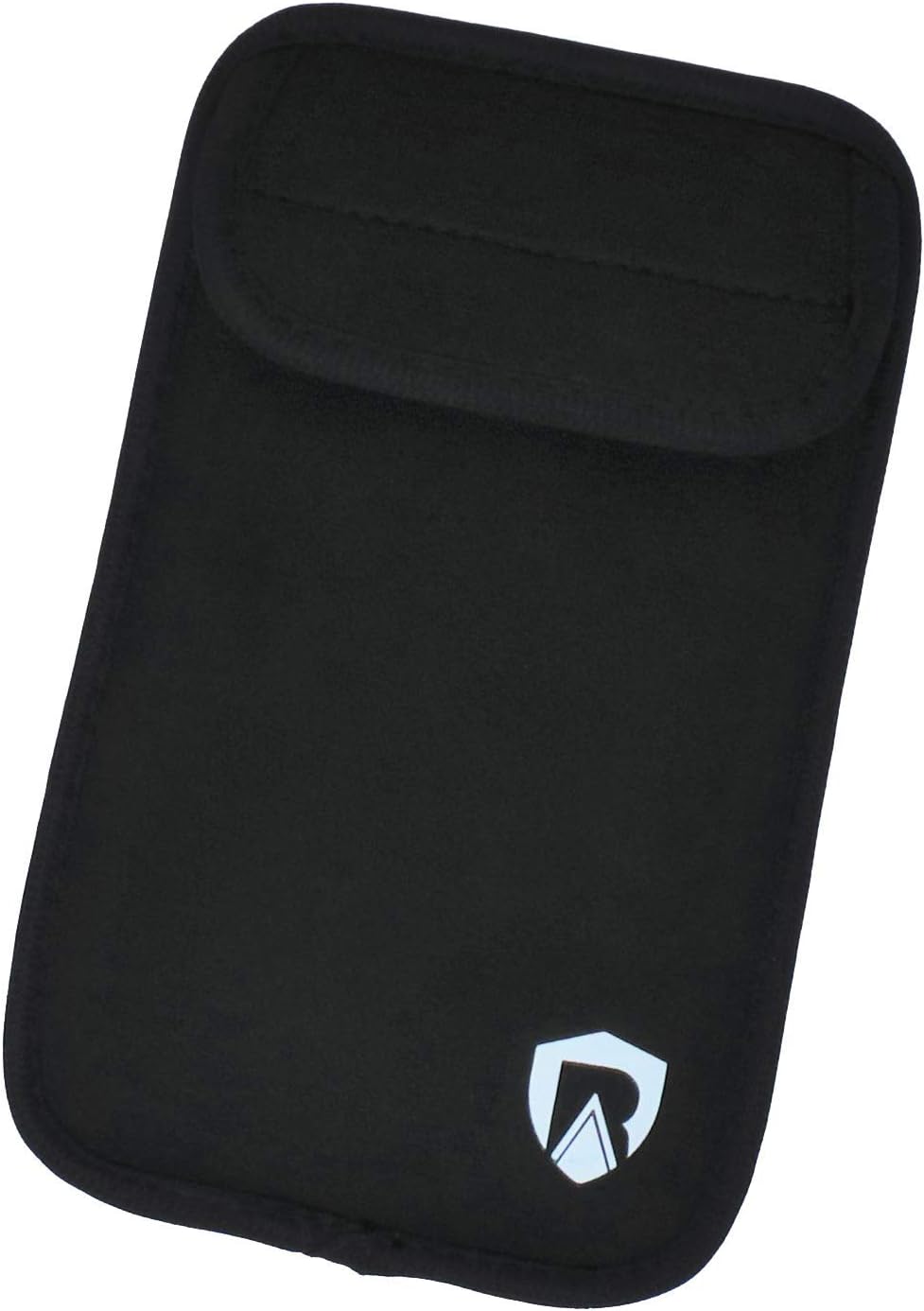
If you’ve ever noticed your phone running warm in your pocket after a long call, or seen the phrase “anti-radiation pouch” pop up in a parenting forum or privacy group, you’re not alone in wondering whether these products actually do anything. Here’s the plain-English version: your phone emits radiofrequency (RF) energy — a type of non-ionizing electromagnetic radiation — whenever it transmits data or makes a call. An anti-radiation phone pouch is a small fabric sleeve or wallet lined with a metal-mesh material (usually silver fiber, copper, or a nickel alloy) designed to absorb or reflect that RF energy before it reaches your body. The key metric that tells you how well a pouch performs is called dB attenuation — decibels of signal reduction. The higher the dB number, the more RF energy the material blocks. In this guide, you’ll learn how to read those numbers, which ones actually matter, and how the leading pouches under $40 stack up on the spec sheets and in aggregated owner feedback.
What dB Attenuation Actually Means (And Why It’s the Only Number That Counts)
Let’s start with the math so you can shop with your eyes open.
Decibels work on a logarithmic scale, which means the jumps between levels are not equal — they compound. Here’s the practical translation:
By the Numbers
| dB Attenuation | Signal Reduction |
|---|---|
| 10 dB | ~90% of RF blocked |
| 20 dB | ~99% of RF blocked |
| 30 dB | ~99.9% of RF blocked |
| 40 dB | ~99.99% of RF blocked |
That jump from 20 dB to 30 dB isn’t “10 points better” — it’s ten times more effective. This is why a pouch that advertises “up to 99% blocking” but only backs it up with a 20 dB spec sheet is worlds apart from one claiming 40 dB, even though both sound impressive in plain language.
Frequency range matters just as much as the peak number. A pouch might hit 40 dB attenuation at 900 MHz (the older 2G/3G band) but only 15 dB at 2.4 GHz (Wi-Fi / Bluetooth) or 5 GHz (newer Wi-Fi and some 5G sub-bands). If a manufacturer only publishes a single dB figure without specifying the frequency, treat that figure with skepticism — it is almost certainly the most favorable number in their tested range, per guidance from the Building Biology Institute’s SBM-2015 testing standards.
Third-party lab certification is the trust signal. The FCC sets SAR (Specific Absorption Rate) limits for phone manufacturers, but it does not independently certify pouch or bag shielding effectiveness. That gap means the market fills up with products making unverifiable claims. Look for pouches that cite testing by an accredited third party — names to look for include SGS, TÜV Rheinland, Intertek, or Bureau Veritas. If a product page lists only “in-house testing” or provides no lab name, that’s a flag worth noting.
The Sub-$40 Market: What You Actually Get at Each Price Point
The $15–$40 phone pouch segment is crowded, and the quality range is genuinely wide. Based on published spec sheets, aggregated reviewer feedback across retail platforms, and data from LessEMF.com’s materials catalog, here’s the honest breakdown by tier.
$15–$22: Entry-Level Pouches
At this price, you’re typically getting a single-layer silver-fiber lining with manufacturer-claimed attenuation of 20–25 dB at 900 MHz. Owners of pouches in this range consistently report that signal drops noticeably (often to zero bars) when the phone is fully inserted and the flap is closed, which is a reasonable real-world indicator of meaningful shielding. The tradeoff: most products in this range do not publish multi-frequency attenuation curves, and independent lab certifications are rare. Build quality in long-run reviews skews toward “functional but basic” — stitching, zipper quality, and RFID sleeve integration are inconsistencies reviewers flag most often.
Who this is for: First-time buyers who want a low-risk introduction to RF shielding and aren’t yet ready to commit to a premium product. Useful for occasional use — meetings, medical appointments, travel — rather than all-day carry.
Representative products in this range to research: Defender Shield Phone Pouch (entry tier), generic silver-fiber sleeves from established shielding retailers like LessEMF. Always verify the dB spec and frequency range before purchasing.
$23–$32: Mid-Range Pouches With Actual Specs
This is where the market starts to reward attention. Several brands publish genuine multi-frequency attenuation data — typically tested at 900 MHz, 1800 MHz, and 2.4 GHz — in the $25–$32 window. Spec sheets in this range from brands with published third-party testing commonly show 30–35 dB across 900–1800 MHz, dropping to 20–25 dB at 2.4 GHz. That’s a meaningful step up from entry level.
Owners in this bracket consistently note that the pouch functions as a practical Faraday enclosure (a shielded container that blocks electromagnetic signals) during storage — useful for privacy-conscious buyers concerned about passive tracking when their phone is not in use. Several mid-range options also include a secondary RFID-blocking slot for credit cards, adding utility for travel buyers.
Who this is for: Daily-carry users, privacy-aware commuters, and anyone who wants verifiable performance without paying premium prices. If you carry your phone in a bag rather than your pocket and want consistent signal-blocking during downtime, this tier is your practical sweet spot.
$33–$40: Approaching Premium Territory
At the top of this budget, you start to encounter products from brands — DefenderShield is the clearest example — that publish full lab reports with third-party certification, multi-band attenuation curves, and stated performance up to and sometimes beyond 5 GHz. Spec sheets for DefenderShield’s phone pouches at this tier show published attenuation figures in the 40–48 dB range at key cellular frequencies, with documented testing by accredited labs. Owners consistently rate the build quality noticeably higher than lower-priced alternatives — materials, seam construction, and closure mechanisms are recurring positive notes in aggregated reviews.
This tier also starts to overlap with pouches that carry dual functionality: they serve as both everyday phone wallets and as forensic-grade device isolation tools when you need to prevent a phone from receiving calls, texts, or location pings entirely.
Who this is for: Users who want documented, independently verified performance and plan to use the pouch daily. Also the right choice for anyone whose use case has a privacy or security dimension — traveling internationally, attending sensitive meetings, or managing a device for handoff in a professional context.
The Certification Question: How to Vet a Product Before You Buy
This is the decision point most buyers skip, and it’s where the market’s noise concentrates. Here’s a practical vetting checklist based on the editorial standards that labs like SGS and TÜV Rheinland apply to shielding effectiveness measurements, as well as guidance from LessEMF.com’s published testing methodology:
-
Find the dB number AND the frequency. A spec that says “blocks RF radiation” with no decibel figure is marketing language, not a performance claim. Reject it.
-
Look for the lab name. SGS, TÜV, Intertek, Bureau Veritas — these are accredited third-party testing organizations. If the product page names a lab, look for whether a report number or certificate ID is cited. That’s the difference between “tested by” and “certified by.”
-
Check the frequency range. Your phone operates on multiple bands — 700 MHz to 2.7 GHz for most current LTE/5G sub-6 GHz use. A pouch that only publishes 900 MHz data is giving you a partial picture. Per NCBI-indexed research on RF shielding measurement standards, testing across a minimum of three to four frequency bands is the accepted floor for a credible shielding claim.
-
Read the return policy. This one is practical, not technical. Because real-world performance depends on proper use (the pouch must be fully closed; phones with external antennas behave differently), a generous return window is a signal of brand confidence in the product’s actual performance.
-
Flag “up to” language. “Blocks up to 99% of RF” is frequently accurate — in a single test at a single favorable frequency. It can coexist with significantly lower performance at the bands your phone actually uses most. The Building Biology Institute’s SBM-2015 guidance specifically recommends evaluating shielding materials across their full intended frequency range, not at a peak.
Decision Rule: If X, Then Y
Here’s the clean decision framework for this tier:
-
If you want to try RF shielding for the first time and aren’t sure you’ll use it daily → start at $15–$22, accept that you’re getting entry-level performance, and treat it as a proof-of-concept purchase.
-
If you plan to use the pouch daily and want confidence in the spec → spend $25–$32, look for multi-frequency attenuation data, and confirm a third-party lab is named somewhere on the product page.
-
If privacy or security is the primary use case (device isolation, meeting hygiene, travel) → go to the $33–$40 ceiling. DefenderShield’s independently certified pouches are the clearest benchmark at this price. The documented lab data is worth the incremental cost.
-
If a product at any price point doesn’t publish a dB figure with a frequency → skip it. That’s not a conservative take; that’s the basic information standard the WHO, FCC, and independent testing labs all use to evaluate shielding claims. Per the FCC’s RF Safety FAQ, consumers deserve transparent, verifiable performance data when making decisions about RF exposure management. A product that won’t show the math isn’t earning your trust.
The $15–$40 window is genuinely capable of delivering real, measurable RF attenuation — but only if you buy the right product for the right reason. The spec sheet exists. Require it.