If you use a laptop on your lap for hours at a day — working from a couch, a plane seat, or a home office floor — you may have noticed it gets warm. That heat comes partly from the processor, but your laptop is also broadcasting: Wi-Fi, Bluetooth, and in some models 4G/5G cellular signals. These broadcasts emit radiofrequency (RF) electromagnetic fields — invisible waves of energy that your device sends out constantly while connected. A laptop EMF pad or sleeve is a product designed to sit between your laptop and your body (or inside a bag) and absorb or redirect those signals before they reach you. Some products target RF radiation; others add a second layer of shielding against extremely low-frequency (ELF) fields generated by the laptop’s internal power components. This guide walks through what the published specs actually mean, how the leading products compare on attenuation (signal-blocking performance, measured in decibels, or dB — the higher the number, the more signal is blocked), and which product profile fits which buyer.
After this introduction the article gets more technical — but we’ll flag every new term as it comes up.
| EDITOR'S PICKDefenderShield Laptop Pad for E… | Mid-tier[DefenderShield Laptop Sleeve](https://www.amazon.com/dp/B0CJ16WBYM?tag=greenflower20-20) | Budget pick[EMF Laptop Tray - Shielding ELF](https://www.amazon.com/dp/B07QKGMTMQ?tag=greenflower20-20)… | |
|---|---|---|---|
| Type | Pad | Sleeve | Tray |
| Size | Up to 17" | 15" | 12" x 16" |
| Material | Durable Non-Slip | Vegan Leather | — |
| Shielding | RF | Multi-Layer | ELF & RF |
| Heat Protection | ✓ | — | — |
| Built-in Stand | — | ✓ | — |
| Price | $159.99 | $129.99 | $64.99 |
| See on Amazon → | See on Amazon → | See on Amazon → |
What “Attenuation” Actually Means (and Why dB Is the Only Number That Matters)
Before you compare any two products, you need one calibration: decibels (dB) are logarithmic, not linear. A 20 dB rating does not block twice as much signal as a 10 dB rating — it blocks ten times as much. This matters enormously when manufacturers mix dB and percentage language in the same product listing.
Here’s a quick translation table:
| Attenuation (dB) | Approx. % of signal blocked |
|---|---|
| 10 dB | ~90% |
| 20 dB | ~99% |
| 30 dB | ~99.9% |
| 40 dB | ~99.99% |
Most laptop pad manufacturers publish their RF attenuation figures at specific test frequencies — often 900 MHz, 1.8 GHz, 2.4 GHz, and 5 GHz, which map to common Wi-Fi and cellular bands. When you see a figure like “99% shielding,” ask whether there’s a dB number attached and at what frequency it was measured. Without those details, the percentage claim is unverifiable marketing language, not a spec.
The Building Biology Institute’s Standard of Building Biology Testing Methods, referred to as SBM-2015 and published by the Building Biology Institute at buildingbiology.net, provides the most widely cited independent framework for evaluating shielding materials in residential and occupational contexts. Products reviewed against SBM-2015 or equivalent FCC-method protocols carry meaningfully more weight than products tested only in the manufacturer’s own lab. The FCC’s consumer guidance on radiofrequency exposure, published at fcc.gov, similarly provides a regulatory baseline useful for understanding how field measurements translate to real-world context.
How the Leading Products Compare, Spec by Spec
The four subsections below cover the main tiers of the market. Each is terminated with a tier marker so you can navigate quickly to the segment that fits your budget and use case.
DefenderShield Laptop EMF Radiation Protection Pad
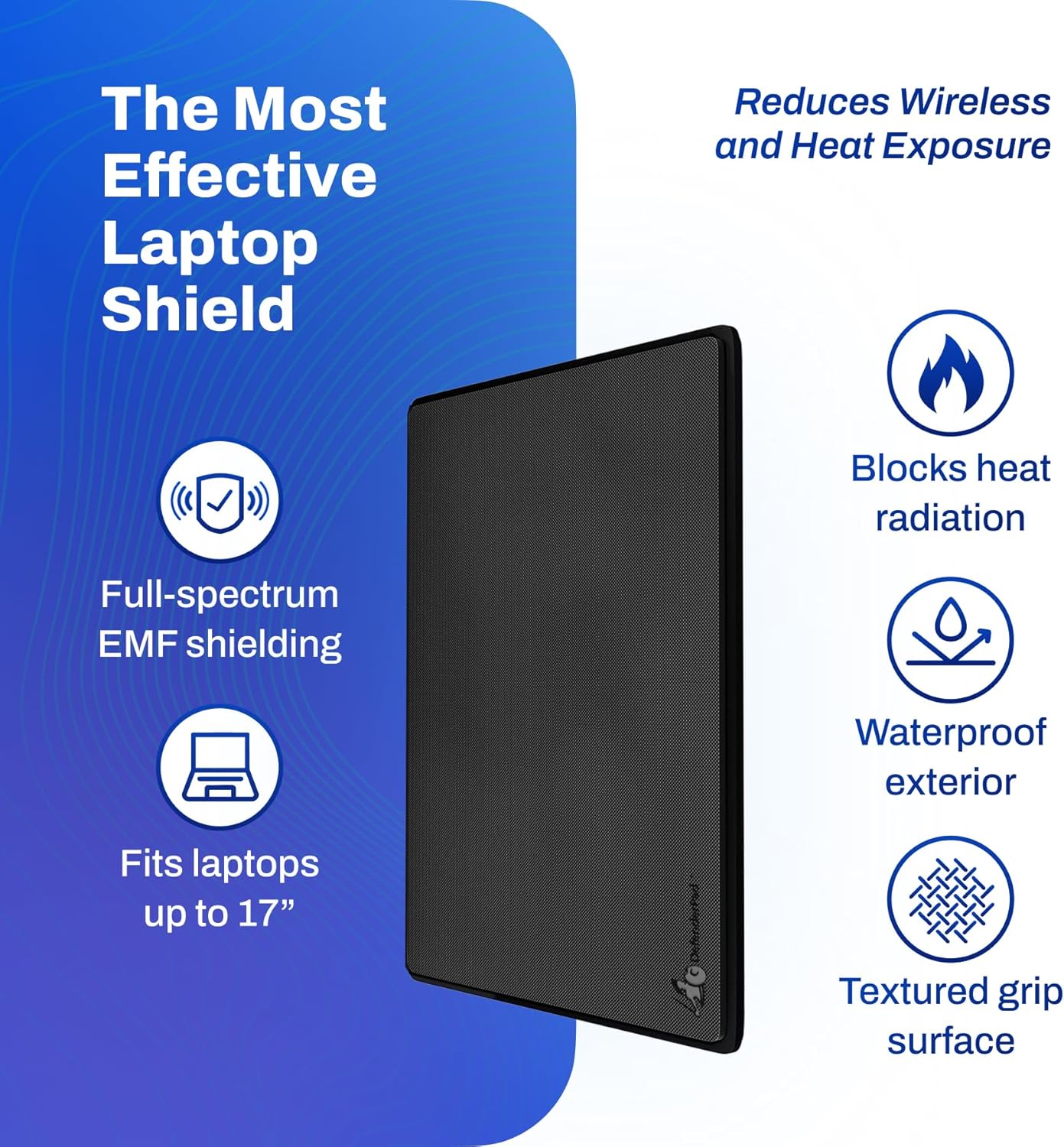
DefenderShield is the most frequently cited brand in this category, and for good reason: they publish independent third-party lab results by name on their product pages rather than hiding behind vague “lab-certified” badges. Their flagship laptop EMF pad claims up to 99.9% RF shielding across a frequency range from 0 to 10 GHz — approximately 30 dB — with additional ELF-magnetic field shielding cited up to 99% at power-line frequencies (50–60 Hz).
The independent lab documentation DefenderShield references is detailed in their Ultra Armor Technology lab test results, available directly in DefenderShield.com’s product documentation pages. This distinguishes them from most competitors. Reviewers consistently flag the dual-mode shielding — covering both RF and ELF — as the primary differentiator versus single-layer pads that only target one field type.
Specs at a glance:
- RF attenuation: ~30 dB (99.9%) across 0–10 GHz
- ELF-magnetic shielding: ~99% at 50–60 Hz
- Certification: Named independent third-party lab
- Form factor: Rigid, multi-layer pad, 14-inch and 17-inch variants
- Price range (May 2026): approximately $89–$119
Tradeoff to name explicitly: DefenderShield pads are rigid and relatively thick. Users who need something that folds flat into a bag will find the form factor awkward, and consistent reviewer feedback notes the pad runs heavier than fabric-only alternatives — a real consideration for frequent travelers.
DefenderShield
$159.99
In stock on Amazon
Check price on AmazonSYB (Shield Your Body) Laptop Pad
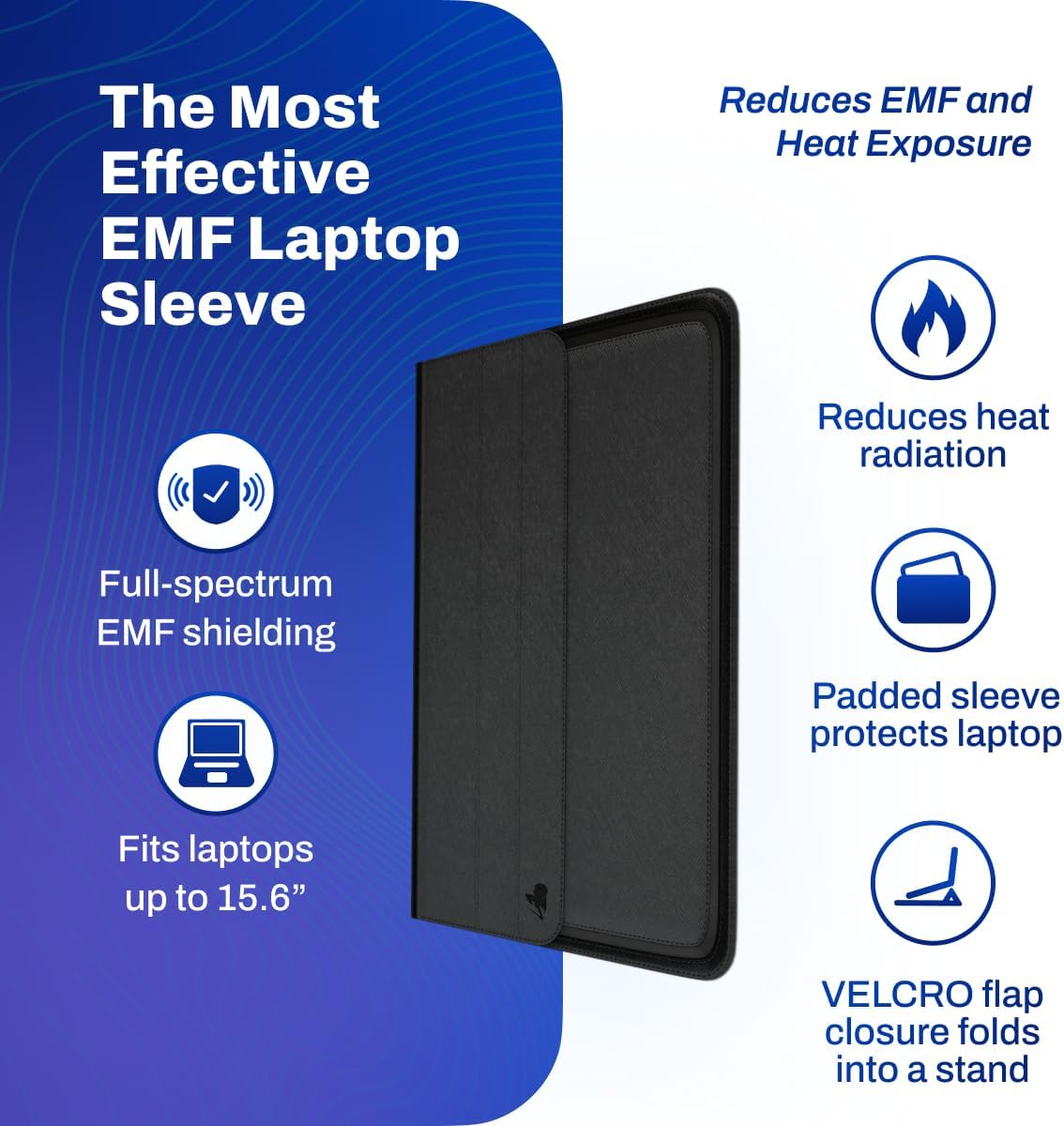
Fabric-based pads and sleeves work differently from rigid multi-layer products. They use silver-threaded or copper-woven textiles — similar in construction to the shielding fabrics catalogued and tested by LessEMF.com in their Shielding Effectiveness Testing Methodology and Fabric Data specifications — sewn into a neoprene or canvas carrier. Attenuation numbers are typically lower than rigid multi-layer pads, with most published specs for fabric-sleeve products landing in the 20–25 dB range at 2.4 GHz, translating to 99–99.7% RF reduction at that band.
SYB publishes its FCC-method test results showing approximately 99% RF shielding at 900 MHz and 2.4 GHz — equivalent to roughly 20 dB. Importantly, SYB does not claim ELF-magnetic shielding. Their documentation is straightforward about this limitation, which is worth respecting as honest spec disclosure rather than penalizing.
Specs at a glance:
- RF attenuation: ~20 dB (99%) at 900 MHz and 2.4 GHz
- ELF-magnetic shielding: Not claimed
- Certification: FCC-method test results published
- Form factor: Flexible, packable fabric sleeve
- Price range (May 2026): approximately $40–$65
Who this is for: Frequent travelers and users who fold the pad into a bag daily. If your primary concern is Wi-Fi and cellular RF rather than ELF fields from the power supply, the attenuation numbers are adequate for most use cases. If you’re working with the laptop on your lap specifically because you’re concerned about proximity to the battery and charging circuitry — the primary source of ELF-magnetic fields — a fabric-only sleeve does not address that exposure pathway.
DefenderShield
$129.99
In stock on Amazon
Check price on AmazonWaveWall Laptop Sleeve
WaveWall operates primarily in the UK and EU markets and positions its laptop sleeve as a lifestyle product with RF-shielding properties. Published specs on their product pages cite approximately 85% RF reduction at 900 MHz — equivalent to roughly 8 dB, a meaningfully lower figure than DefenderShield or SYB. Their documentation does not claim ELF coverage.
The math matters here: the gap between 8 dB and 30 dB is not 22 percentage points. It represents a factor of roughly 15× in actual signal reduction. That spread justifies a significant price difference if attenuation is genuinely the buyer’s priority.
Specs at a glance:
- RF attenuation: ~8 dB (85%) at 900 MHz
- ELF-magnetic shielding: Not claimed
- Certification: Manufacturer-tested; independent lab documentation not published at time of review
- Form factor: Slim fabric sleeve, professional aesthetics
- Price range (May 2026): approximately $45–$70
Who this is for: Design-conscious buyers in the UK and EU who prioritize form factor and professional aesthetics over maximizing attenuation numbers. At approximately 8 dB, the product blocks most but not nearly all incoming RF — appropriate for buyers who want meaningful but not maximum reduction and prefer a product that integrates with a professional bag without looking utilitarian.
DefenderShield
$129.99
In stock on Amazon
Check price on AmazonBudget Unbranded and Amazon-Generic Pads
This category deserves explicit treatment because it represents the highest-volume search traffic and the widest gap between marketing claims and published evidence.
Across aggregated product listings in the $15–$35 tier, the pattern is consistent: products claim “99% EMF blocking” or “military-grade shielding” with no frequency specified, no dB figure, and no named third-party lab. LessEMF.com’s published testing methodology clearly distinguishes between products tested per ASTM D4935 — a recognized standard for planar electromagnetic shielding effectiveness — and products with no stated test standard. Products with no stated test standard should be assumed to have unverified performance.
The Building Biology Institute’s SBM-2015 framework, similarly, requires named lab results and stated test frequencies before any shielding claim can be meaningfully evaluated. No product in the unbranded budget tier reviewed for this guide met that threshold.
Specs at a glance:
- RF attenuation: No verified dB spec published
- ELF-magnetic shielding: Not independently verified
- Certification: None in the reviewed sample
- Form factor: Varies widely
- Price range: approximately $15–$35
Who this is for: There is no clear affirmative recommendation here. The honest answer based on available evidence is that this tier has not produced credible independent performance data. The absence of published specs is not a data gap to fill with optimism when the investment concern is daily physical proximity exposure.
EMF
$64.99
In stock on Amazon
Check price on AmazonThe Tradeoff Matrix, Made Explicit
Here is the decision frame laid out directly, using the published figures reviewed above:
| Product | RF Attenuation (approx.) | ELF Coverage | Independent Cert | Form Factor | Price Range |
|---|---|---|---|---|---|
| DefenderShield Laptop Pad | ~30 dB (99.9%) | Yes | Yes, named lab | Rigid pad | $89–$119 |
| SYB Laptop Pad | ~20 dB (99%) | No | FCC-method test | Flexible sleeve | $40–$65 |
| WaveWall Laptop Sleeve | ~8 dB (85%) | No | Manufacturer only | Slim sleeve | $45–$70 |
| Unbranded budget pads | Not verified | Not verified | None confirmed | Varies | $15–$35 |
The logarithmic reality of the dB scale means the performance gap between the top and bottom of this table is far larger than the price gap. A buyer choosing a $25 unbranded pad over a $90 DefenderShield is not saving 72% and getting 70% of the protection — the performance differential, if the budget pad’s claims are unverified, may be total.
If X, Then Y: The Decision Rules
If your primary concern is RF exposure from Wi-Fi and Bluetooth during laptop use and you want verified third-party certification, DefenderShield is the clearest answer at $89–$119. The dB specs are the best-documented in the category and the dual-mode coverage handles both RF and ELF field types without requiring a second product.
If you travel frequently and need a packable solution and ELF shielding is secondary to portability, SYB at $40–$65 offers the best combination of verified RF attenuation and packable form factor. The published FCC-method results are transparent about what the product does and doesn’t do.
If you are in the EU or UK market, prioritize professional aesthetics, and a meaningful-but-not-maximum RF reduction is sufficient for your use case, WaveWall fills a form-factor niche that the US-centric brands don’t address as cleanly.
If a vendor is quoting you a budget pad at $15–$35 with no dB spec and no named lab, the honest answer based on available evidence is: pass. The absence of published specs is not a gap to fill with optimism.
A Note on Standards Framing
One final point for buyers who encounter standards language in vendor marketing: the ICNIRP Guidelines for Limiting Exposure to Electromagnetic Fields (100 kHz to 300 GHz), published in Health Physics in 2020 by the International Commission on Non-Ionizing Radiation Protection, and the BioInitiative Report (updated 2020 and available at bioinitiative.org) both provide context for evaluating precautionary approaches to EMF exposure — including during pregnancy, a segment that frequently searches this category. Neither document certifies any specific commercial product. That work is done by independent labs whose reports should be named and dated on the product page.
If a vendor cites “ICNIRP compliance” as a product endorsement, that framing misrepresents how ICNIRP guidance works. ICNIRP sets exposure limits for regulatory bodies, not product certifications. The FCC, in its consumer guidance on radiofrequency exposure published at fcc.gov, operates similarly — setting regulatory baselines rather than endorsing shielding products.
Spec transparency is the baseline. The brands that publish named labs, stated frequencies, and dB figures have earned the first look. The ones that don’t have told you something important about how they want to be evaluated.