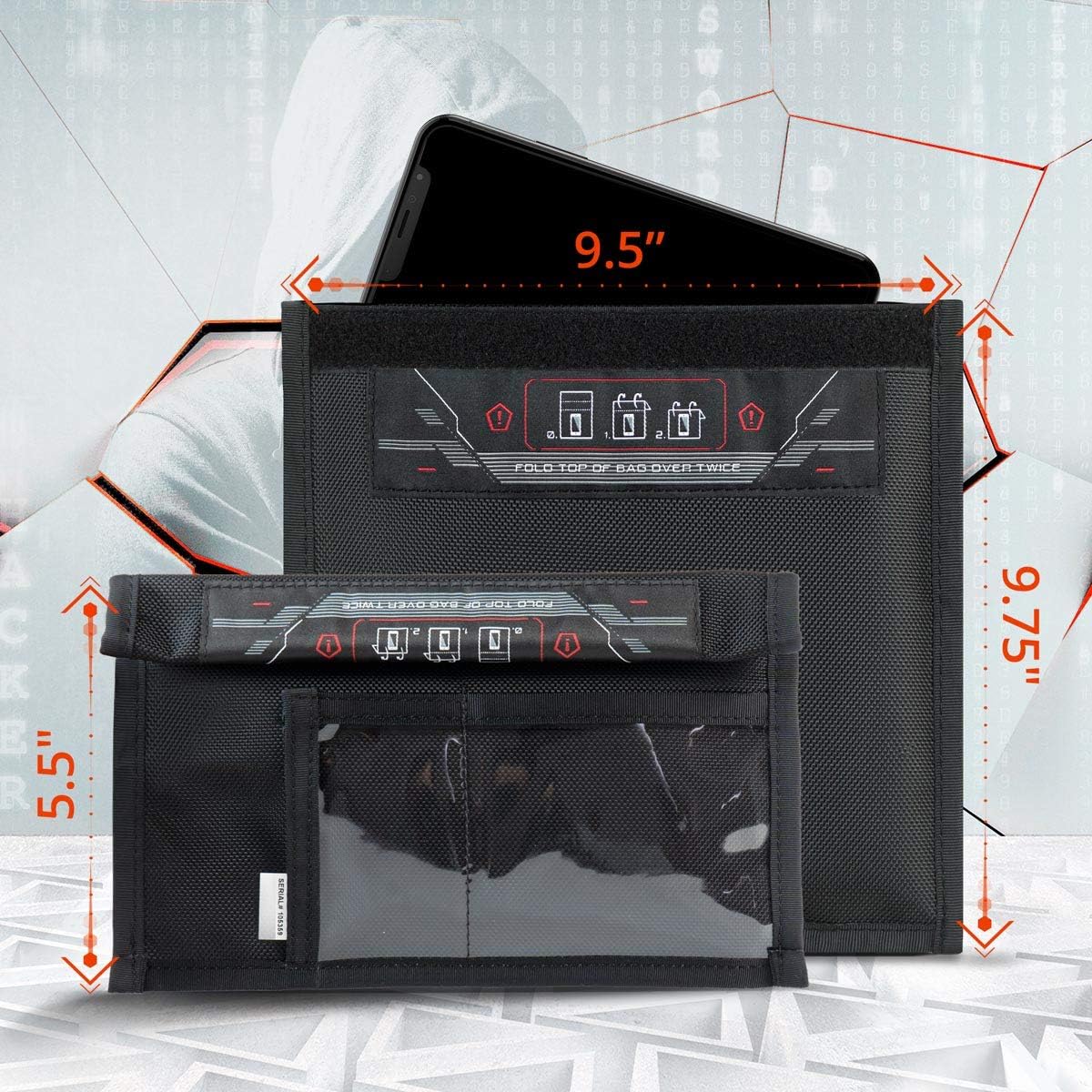
A Faraday bag is simply a pouch or enclosure lined with conductive shielding material — usually layers of metallic fabric or foil — that blocks radio-frequency (RF) signals from reaching whatever is inside. Think of it as a signal-proof envelope: your phone can’t receive a call, your car key fob can’t be remotely cloned, and your RFID-chipped passport can’t be skimmed. The concept sounds almost magical, but it’s straightforward physics: the metallic lining absorbs or reflects electromagnetic waves instead of letting them pass through. If you’ve ever noticed your phone losing reception inside an elevator with metal walls, you’ve experienced a crude version of the same effect.
This article walks through four distinct real-world scenarios — key fob relay theft prevention, laptop privacy and forensic isolation, passport RFID blocking, and EMP (electromagnetic pulse) surge protection — and explains what the published specs actually mean for each one. By the end, you’ll know which bag categories are genuinely fit for purpose, which claims deserve skepticism, and how to match a product’s attenuation rating to your actual threat model.
What Attenuation Numbers Actually Mean (and Why They Matter)
When a manufacturer says a bag provides “60 dB of attenuation,” they’re describing signal reduction on a logarithmic scale. Decibels (dB) work differently from percentages, and the gap between a 40 dB bag and a 60 dB bag is far larger than it looks.
By the numbers:
- 20 dB = 99% of signal blocked
- 40 dB = 99.99% blocked
- 60 dB = 99.9999% blocked
- 80 dB = 99.999999% blocked (forensic-grade)
This matters because different use cases have different minimum thresholds. A relay attack on a passive-entry car key fob exploits signals as weak as −100 dBm, so a bag with only 30–40 dB of attenuation may not fully sever the link under real-world conditions — the residual signal can still be amplified by a determined attacker with boosting hardware. Forensic-grade device isolation, by contrast, typically requires 80 dB or better per NIST Special Publication 800-101 Rev. 1, which outlines guidelines for mobile device forensics used by law enforcement.
The second thing to understand is frequency coverage. A bag might block cellular bands (700 MHz–2.7 GHz) beautifully but perform poorly at Wi-Fi 6E (6 GHz) or GPS (1.575 GHz). Always check that the published spec covers every frequency band relevant to your device. Responsible manufacturers publish multi-band attenuation tables; if a product page only lists a single number with no frequency reference, treat that as an incomplete spec.
Scenario 1: Key Fob Relay Attack Prevention
The threat: Modern passive-entry car systems listen for a rolling cryptographic signal from your key fob. Thieves use a two-person relay device — one unit near your front door, one near your car — to bridge the distance and trick your car into unlocking. This is not theoretical; insurance industry data referenced in a 2024 Thatcham Research vehicle security report notes relay theft as a leading factor in keyless-entry vehicle theft across Europe and North America.
What you need: At a minimum, 50–60 dB of attenuation across the 315 MHz and 433 MHz UHF bands used by most North American and European key fobs. Some luxury vehicles use 125 kHz LF signals for the initial handshake — a frequency that cheaper bags often don’t list in their spec tables, so ask explicitly.
Decision frame:
- Budget pouches in the $15–$25 range frequently publish no independent lab data and list attenuation in vague terms like “blocks signals.” Treat these as unverified.
- Mid-range options ($25–$50) from brands like Faraday Defense or Wisdompro sometimes include self-published attenuation figures but lack third-party certification. Functional for everyday deterrence, not adversarial threat models.
- Mission Darkness TitanRF Faraday Fabric-based key fob pouches publish attenuation figures derived from MIL-STD-461 methodology testing — reviewers on long-form automotive security forums consistently note clean signal dropoff when verified with signal strength apps.
If X, then Y: If your primary concern is casual relay theft and you park in a residential area, a $20–$35 pouch with published frequency coverage is a reasonable starting point. If you drive a high-value vehicle in an urban environment where targeted relay attacks are documented, invest in a pouch with published third-party lab data at 60 dB+ across both UHF and LF bands.
Scenario 2: Laptop and Device Forensic Isolation
The threat: A device that remains connected to Wi-Fi, Bluetooth, or cellular can receive remote-wipe commands, sync data to the cloud, or have its location logged. In legal investigations, corporate forensics, and journalism source protection, maintaining the integrity of a device’s state at the moment of seizure requires complete RF isolation — meaning zero signal in or out.
What you need: 80 dB or better across cellular, Wi-Fi (2.4 GHz and 5 GHz), Bluetooth (2.4 GHz), and GPS (1.575 GHz). NIST SP 800-101 Rev. 1 explicitly recommends Faraday enclosures for this purpose, noting that even brief connectivity windows can compromise evidentiary integrity.
Products worth examining:
Mission Darkness Non-Window Laptop Faraday Bag is the most frequently cited option in forensic-adjacent discussions. The manufacturer publishes attenuation data derived from third-party RF shielding effectiveness testing, claiming 80 dB+ from 10 MHz to 26 GHz. Law enforcement evidence technicians and digital forensics practitioners on professional forums consistently reference this bag as a working standard. Priced around $80–$110 as of May 2026.
DefenderShield Universal Faraday Bag for Laptops takes a different positioning — it’s marketed toward privacy-conscious professionals and remote workers rather than strict forensics, and its published specs are oriented toward consumer-band RF (cellular and Wi-Fi). Owners report reliable signal blocking for everyday use; the spec sheet is less granular at the high-frequency end relevant to forensic-grade isolation.
Who this is for: The Mission Darkness forensic bag is for enterprise IT security teams, legal professionals, and journalists operating under adversarial conditions. The DefenderShield is the better fit for a business traveler who wants device privacy in hotel rooms or client offices without needing lab-grade isolation.
If X, then Y: If you’re managing evidence integrity or working in a regulated forensic chain-of-custody environment, buy to the NIST standard — 80 dB+ with third-party documentation. If you’re a privacy-aware professional wanting to prevent casual surveillance or tracking while traveling, a published-spec bag in the 60–70 dB range is likely sufficient and easier to carry.
Scenario 3: Passport and RFID Card Blocking
The threat: Since 2007, U.S. passports and most modern credit cards embed RFID chips (passports use 13.56 MHz NFC). Skimming — reading that chip wirelessly without your knowledge — is a documented risk in dense urban environments, per the FCC’s consumer RF safety documentation, though the practical exploit window on newer cards with rolling cryptographic tokens is narrow. Older cards and some foreign passports carry weaker protections.
What you need: Attenuation at 13.56 MHz NFC and, for older fobs or transit cards, 125 kHz LF. This is a lower-energy frequency range than cellular, so the shielding threshold is more achievable — even budget sleeves can hit functional blocking levels here.
The honest tradeoff: This is the category with the most marketing noise and the least need for high-spec engineering. A $10–$20 RFID-blocking sleeve from a reputable brand (Travelambo, Helseth, Alpine Rivers) will functionally block NFC reads for a passport or credit card. The real differentiators are durability of the lining over time, whether the sleeve holds its shape, and whether it’s also covering the 125 kHz band.
Where it gets more interesting: full Faraday passport wallets that also block cellular (so your phone and passport travel together in one pouch) add meaningful protection for journalists or travelers crossing borders under surveillance conditions. Mission Darkness makes a dual-pocket version that covers both NFC and cellular.
If X, then Y: If RFID blocking is your only concern, a purpose-built $15–$25 sleeve with published NFC blocking is sufficient. If you’re a frequent traveler concerned about location tracking and border surveillance, a cellular-plus-NFC Faraday wallet at $40–$70 closes more threat vectors.
Scenario 4: EMP Protection
The threat: An electromagnetic pulse — whether from a nuclear detonation at altitude, a non-nuclear EMP weapon, or a severe geomagnetic storm (Carrington-class solar event) — generates a broadband burst of electromagnetic energy that can induce damaging currents in electronic circuits. The concern is real enough that the U.S. Congressional EMP Commission has produced multiple threat assessment reports, with the most recent 2017 update warning of vulnerabilities in infrastructure electronics.
What this category actually does (and doesn’t do): EMP protection is where Faraday bag claims require the most scrutiny. A well-constructed Faraday enclosure can attenuate EMP-induced fields significantly, but the physics of EMP — especially the fast-rise-time E1 component — places demands on shielding continuity (no gaps, no seams, complete grounding paths) that fabric-based bags handle imperfectly compared to rigid metal enclosures.
Brands like Mission Darkness and Ready-to-Go Gear publish EMP-rated bags that use double-rolled seam construction and multiple conductive layers specifically to address this. Mission Darkness’s TitanRF fabric, tested per MIL-STD-461G methodology, is the most frequently referenced spec in preparedness and ham radio communities. However, independent engineering sources — including guidance from the Ramsey Electronics RF shielding technical note — consistently note that fabric Faraday bags are best categorized as partial EMP mitigation, not equivalent to a grounded metal enclosure for the most severe E1 pulse scenarios.
If X, then Y: If your EMP concern is grid-down preparedness for solar storm scenarios (E3 component, slower rise time), a quality double-seam Faraday bag at 60–80 dB published attenuation is a practical and cost-effective layer of protection for small electronics — backup drives, communication devices, solar charge controllers. If your threat model centers on a high-altitude nuclear EMP (E1 component), a nested solution — rigid metal ammo can lined with insulating foam, with a Faraday bag as a secondary layer inside — is the engineering-grounded approach.
The Certification Question: What to Demand Before You Buy
Across all four scenarios, the single fastest filter is this: does the manufacturer publish attenuation data with a frequency range, a test methodology reference (MIL-STD-461, IEEE 299, or equivalent), and either third-party lab documentation or a clearly named testing partner?
If the answer is no — if the product page says only “blocks EMF” or shows a marketing graphic without numbers — that’s not a product specification, it’s a claim. This site’s position is consistent: flag products that publish no dB spec and carry no independent certification. You are making a real purchasing decision, often to protect something that matters — a car, a laptop, a document, stored electronics. The spec should be there.
A useful shorthand: brands publishing MIL-STD-461 test methodology references are making a verifiable engineering claim. Brands publishing no methodology at all are asking you to take their word for it.
Quick Decision Matrix
| Use Case | Minimum Spec | Certification to Look For | Price Range |
|---|---|---|---|
| Key fob relay theft | 60 dB @ 315–433 MHz | MIL-STD-461 or third-party RF lab | $25–$55 |
| Laptop forensic isolation | 80 dB, 10 MHz–26 GHz | Third-party lab report, NIST-aligned | $80–$150 |
| Passport / RFID blocking | Functional NFC block @ 13.56 MHz | Published test or independent review | $15–$40 |
| EMP preparedness | 60–80 dB, double-seam construction | MIL-STD-461G methodology reference | $40–$200+ |
The Faraday bag category rewards buyers who ask one question before everything else: where’s the spec? When you find the published number, the frequency range, and the test methodology, the decision gets straightforward. When those are missing, the decision has already been made for you — move on.