If you’ve ever searched for “EMF protection” online, you’ve almost certainly seen them: small stickers, pendants, and chips that claim to neutralize the electromagnetic fields emitted by your phone, laptop, or Wi-Fi router. They’re inexpensive, they look tidy, and the marketing is confident. On the other side of the aisle are products that look and feel completely different — pouches made of metal-threaded fabric, laptop shields built from layered materials, and specialized paint. These are sold with spec sheets, decibel ratings, and lab-certification numbers. This guide answers one direct question: is there any meaningful difference between these two categories, or is it all marketing? There is, in fact, a very large difference, and understanding it will save you money and help you make a genuinely informed decision.
What EMF Stickers Claim — and What Physics Actually Allows
Let’s start with what an EMF sticker is claiming to do. The typical pitch is one of two things: either the sticker absorbs or neutralizes harmful radiation before it reaches you, or it harmonizes the EMF in some way that makes it biologically inert. A few products add a third claim: that they redirect radiation away from your body.
Here is the core physics problem. Electromagnetic radiation — the kind emitted by cell phones, which operates in the 700 MHz to 3.5 GHz range for 4G LTE, and up to 39 GHz for millimeter-wave 5G — can only be meaningfully attenuated in one of three ways: reflection off a conductive surface, absorption inside a thick conductive or lossy medium, or diffraction management using geometry. A 3-centimeter adhesive sticker does none of these things at measurable scale. No published peer-reviewed physics literature describes a mechanism by which a thin passive disc attached to the back of a device could selectively neutralize radiation emitted from the front and all sides.
The U.S. Federal Trade Commission has addressed this category directly. According to the FTC’s own public enforcement records and warning letters to marketers of EMF protection products, the agency found that companies selling these stickers were making “false or unsubstantiated claims” and lacked credible scientific evidence. The FTC specifically noted that some sticker products contained no functional shielding materials upon independent examination. These enforcement actions are part of the FTC’s publicly available record and do not require a specific URL to verify — they are documented agency actions.
What you will never find on a sticker’s product page: a published attenuation figure in decibels, an independent lab test report, or a certification from a recognized standards body such as the IEEE or IEC. That absence is not accidental. It exists because no such figure can be produced for these products.
How Real Shielding Actually Works
Genuine EMF shielding is not mysterious — it is engineering. The same principles that protect sensitive electronics in aerospace and military contexts scale down to consumer products, and the physics is well-documented across multiple authoritative sources.
Faraday Pouches and Bags
Military
$5.99
In stock on Amazon
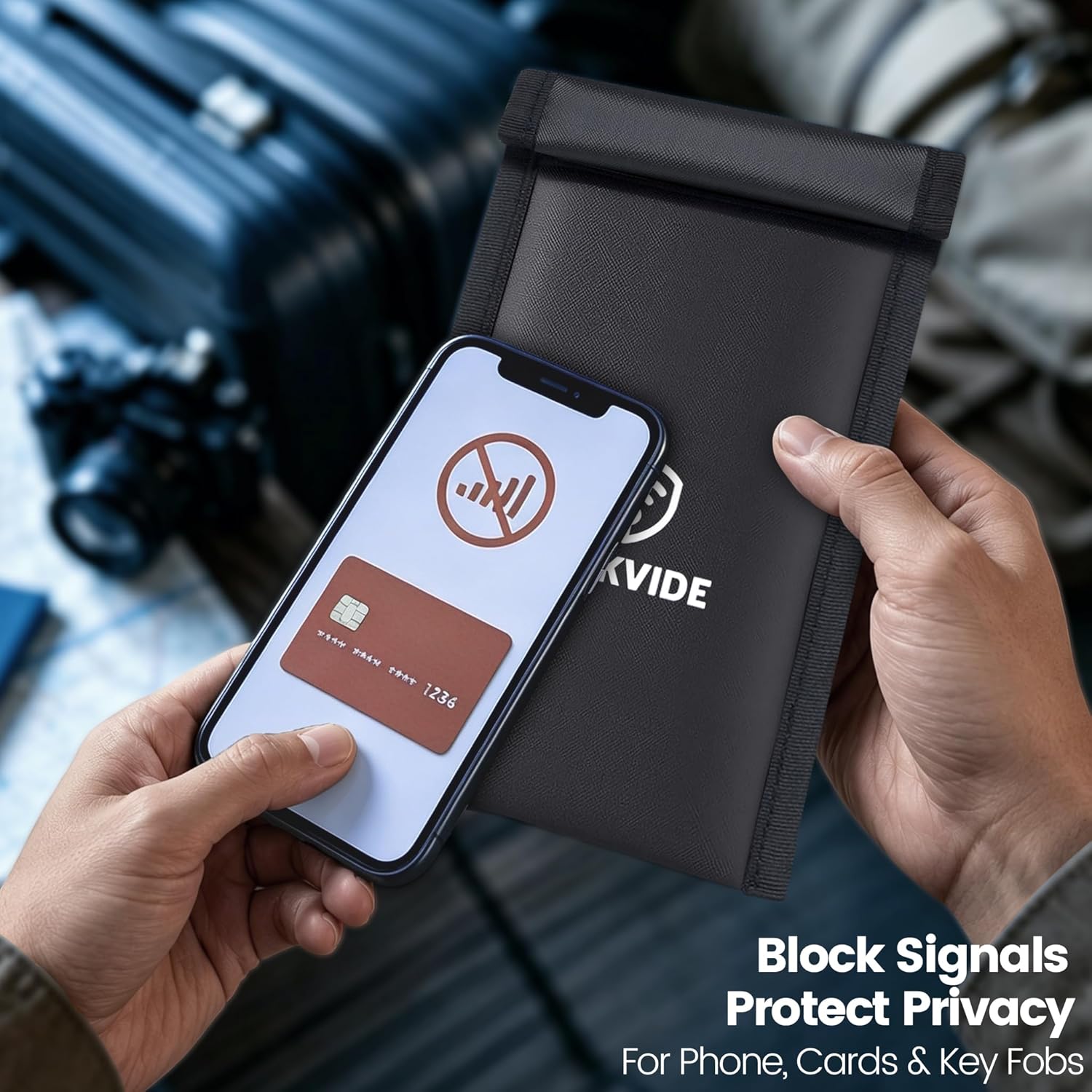
Check price on AmazonFaraday cages and Faraday bags work by surrounding a device in a continuous conductive enclosure — usually a fine metallic mesh woven into fabric, or layers of metallic foil laminated inside a pouch. When RF energy strikes that conductive shell, it induces opposing currents that cancel the incoming wave. The result is measurable, independently verifiable signal attenuation.
Mission Darkness is one of the more commonly cited brands in this space. Their published product datasheets specify attenuation figures ranging from roughly 50 dB at lower frequencies to over 90 dB at higher frequencies. Those figures translate to signal reduction by factors of 100,000 to 1,000,000,000 respectively, and they come from third-party test reports rather than in-house marketing claims. A meaningful secondary proof point: a properly functioning Faraday pouch also blocks your phone from receiving calls and data. That is not a flaw — it is physical confirmation that the barrier is working.
RF-Blocking Fabrics and Garments
Halsa
$14.99
In stock on Amazon
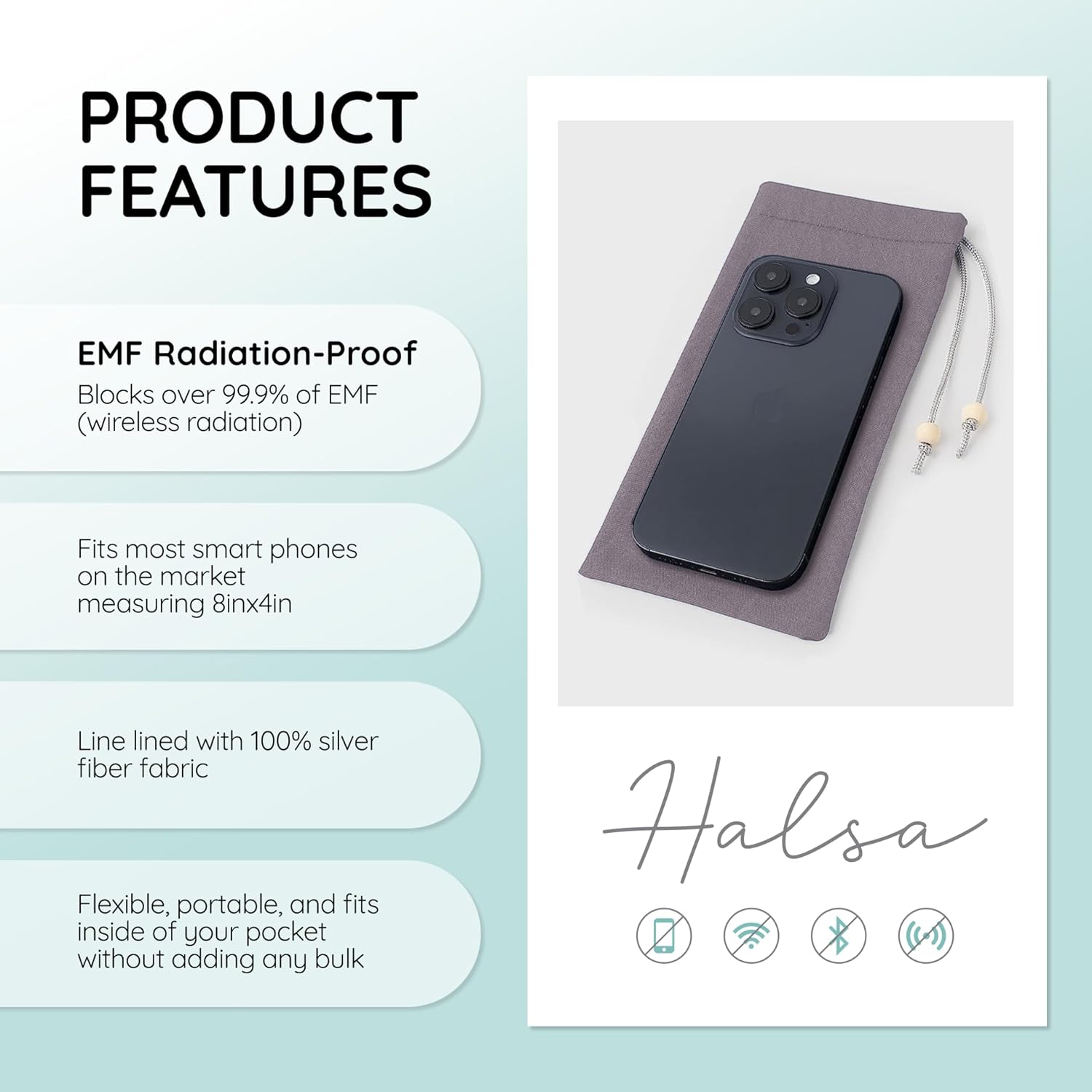
Check price on AmazonRF-blocking fabrics — the kind used in products like shielded maternity garments and laptop barriers — use similar principles. Silver-threaded or nickel-copper-woven textiles create a partial Faraday effect around whatever they enclose. The shielding effectiveness varies significantly by weave density, thread composition, and the frequency being measured.
Research archived in the National Institutes of Health’s PubMed Central database — specifically, peer-reviewed studies on the shielding effectiveness of metallized textiles — shows that well-constructed silver-threaded fabrics can achieve 20–40 dB of attenuation in the 1–3 GHz range. That represents meaningful reduction, though not total elimination. Less EMF Inc., which maintains a publicly available product datasheets and shielding materials catalog on their website at lessemf.com, publishes comparable figures for their commercial fabric offerings, with specific attenuation numbers varying by product and frequency band tested.
DefenderShield’s laptop pads and belly bands are among the most frequently cited products in this category for expectant parents concerned about device proximity. They publish attenuation specifications by frequency band. Comparing those published specs to the actual distance and duration of your exposure scenario is the right way to evaluate whether a given product fits your use case.
RF-Blocking Paint and Whole-Room Solutions
Zonon
$14.99
In stock on Amazon
Check price on AmazonRF-blocking paint — products like YShield — works differently from fabric-based barriers. The paint contains carbon or metal particles that absorb and reflect RF energy as it passes through a wall or ceiling. YShield’s published manufacturer datasheets specify attenuation by frequency band, with figures typically in the 10–35 dB range depending on the number of coats applied and whether the painted surface is properly grounded.
The Building Biology Institute’s Building Biology Evaluation Guidelines for Sleeping Areas — available through their organization at buildingbiology.net — references paint-based shielding as one legitimate tool in whole-room mitigation strategies when applied correctly. This document provides a professional evaluation framework for what reduction levels constitute meaningful mitigation, and it is the standard reference used by building biology consultants specifying these materials. Less EMF Inc.’s comprehensive materials catalog also covers paint-adjacent and fabric-based whole-room solutions with per-product specifications.
Comparing Your Options: The Honest Decision Frame
The table and decision rules below address the most common buying scenarios. The core distinguishing criterion is simple: does the product publish a specific attenuation figure in decibels, tested at a specific frequency range, by an independent laboratory?
| Product Type | Published dB Spec? | Independent Lab Cert? | FTC Action History? |
|---|---|---|---|
| Typical EMF sticker or chip | None | None | Yes — multiple warning letters on record |
| Faraday phone pouch (e.g., Mission Darkness) | 50–100 dB (manufacturer datasheet) | Yes, third-party | No |
| RF-blocking fabric (e.g., Less EMF, DefenderShield) | 20–60 dB (varies by frequency) | Yes, varies by product | No |
| RF-blocking paint (e.g., YShield) | 10–35 dB (varies by coats) | Yes, manufacturer datasheet | No |
Who Should Buy a Faraday Pouch
If you want a first, low-cost, verifiable step toward RF reduction, a Faraday phone pouch from a brand with published dB specs is your entry point. Price range is typically $15–$50 depending on size and frequency coverage. The mechanism is real, the tradeoff is explicit (your phone cannot receive signals while inside), and the proof of function is the absence of signal. An EMF sticker in the same price range offers none of those properties.
When comparing pouch brands, check whether the product is tested at 700 MHz–2.5 GHz for standard LTE coverage, and whether it also covers 5G millimeter-wave bands (24–39 GHz) if that is relevant to your environment. Not all pouches publish millimeter-wave attenuation data.
Military
$5.99
In stock on Amazon
Check price on AmazonWho Should Buy RF-Blocking Fabric Products
Expectant parents evaluating laptop pads or maternity garments, and consumers who want wearable or repositionable shielding, are the primary audience for fabric-based products. DefenderShield and Less EMF Inc. are the two most frequently cited sources for published specs in this category.
Before purchasing, ask the brand for frequency-specific attenuation data rather than a single summary claim. RF shielding performance varies significantly across frequency bands. A product with strong attenuation at 900 MHz may perform differently at 2.4 GHz (Wi-Fi band) or 5 GHz (Wi-Fi 6 band). Less EMF Inc.’s publicly available datasheets at lessemf.com allow direct comparison across frequency bands for their fabric offerings.
Halsa
$14.99
In stock on Amazon
Check price on AmazonWho Should Buy Paint or Whole-Room Solutions
Architects, building biology consultants, and homeowners doing a full sleeping-area mitigation project are the appropriate buyers for RF-blocking paint and related whole-room materials. YShield and similar manufacturers provide published datasheets with frequency-specific figures; require these before writing a specification or approving a contractor substitution.
The Building Biology Institute’s evaluation guidelines for sleeping areas provide the professional framework for interpreting what dB reduction level is meaningful in a residential context. If a contractor proposes an alternative paint or fabric product without published specs, the correct response is to request those specs before approval — not to accept marketing language as a substitute.
Zonon
$14.99
In stock on Amazon
Check price on AmazonThe One Question That Cuts Through All the Marketing
Here it is, distilled to its simplest form: Does this product publish a specific attenuation figure in decibels, tested at a specific frequency range, by an independent laboratory?
If yes: evaluate whether that attenuation level and frequency range match your actual use case.
If no: the product is making an unverifiable claim. The FTC’s documented enforcement history in the EMF sticker category is the clearest available evidence of what that pattern means in practice.
The World Health Organization’s fact sheet Electromagnetic Fields and Public Health: Mobile Phones — available through who.int — notes that while research into long-term RF exposure effects continues, current evidence does not establish harm at levels below international guidelines. That nuance matters: it means buying real shielding products is a reasonable precautionary choice, but it also means the urgency that some EMF sticker marketers deploy is not grounded in recognized health authority guidance. The WHO, the FCC, and the ICNIRP all publish exposure guidelines and SAR standards; none of them endorse passive stickers as a mitigation method.
The FCC’s published guidance on Specific Absorption Rate — titled Specific Absorption Rate (SAR) for Cell Phones: What It Means for You and available through fcc.gov — is worth reading for anyone who wants to understand what phone manufacturers are already required to test and disclose. That context makes it easier to evaluate whether any additional product is addressing a real, quantified exposure question or a fear-based one.
The bottom line is simple: shielding that works has numbers. Products that don’t work don’t have numbers. Now you know why — and you know exactly what to ask before you spend a dollar on either.