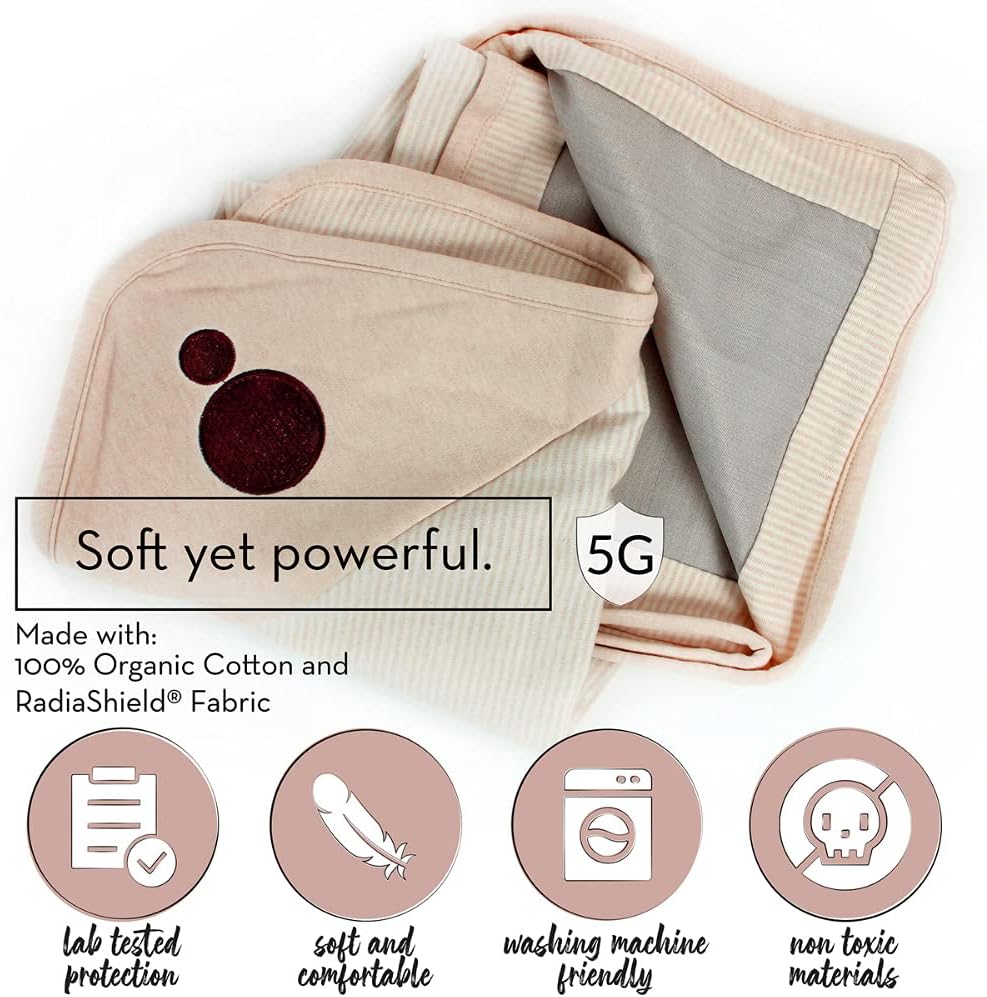
If you’re newly pregnant — or planning to be — you’ve probably already landed in the corner of the internet where people talk about EMF exposure and unborn babies. EMF stands for electromagnetic fields, the invisible energy emitted by Wi-Fi routers, cell phones, and other wireless devices. Whether or not that exposure poses a documented risk during pregnancy is a genuinely unsettled scientific question (more on that below), but the products designed to address the concern are very real, increasingly sophisticated, and selling briskly in 2026. This article focuses on one specific category: EMF-blocking blankets and belly wraps — garments or fabric panels woven with conductive metal fibers that are designed to intercept RF (radio-frequency) radiation before it reaches your abdomen. We’ll walk through how the shielding actually works, compare the two most-cited brands (Radia Smart and Belly Armor), decode the numbers on their published specs, and give you a clear framework for deciding whether one belongs in your registry.
What “EMF-Blocking Fabric” Actually Means
Before comparing brands, it helps to understand the mechanism. Standard fabric — cotton, polyester, bamboo — does nothing to block radio waves. EMF-blocking textiles work by weaving metallic fibers (silver, stainless steel, or a silver-coated nylon blend) into the base fabric. These conductive threads form a mesh that reflects and absorbs incoming RF energy — the same physics principle behind a microwave oven’s metal door screen. The effectiveness of that mesh is measured in decibels of attenuation (dB), which expresses how much of the incoming signal is blocked. A 20 dB rating means 99% of the signal is reduced; 30 dB means 99.9%. Those numbers come from standardized lab tests, usually performed in a shielded enclosure using calibrated antennas.
The frequencies that matter most for everyday device exposure are in the RF range: roughly 100 MHz to 6 GHz, covering Wi-Fi (2.4 GHz and 5 GHz), LTE/4G (~700 MHz–2.5 GHz), and 5G sub-6 GHz bands. Any blanket worth considering should publish attenuation data across this range, not just at a single convenient frequency. When you see a brand cite only one number — say, “blocks 99% of EMF” — without specifying frequency or a lab source, that’s a red flag.
The World Health Organization’s fact sheet on electromagnetic fields (WHO, Fact Sheet No. 193) acknowledges that RF fields are classified as “possibly carcinogenic to humans” (Group 2B by IARC) and notes that research on prenatal exposure is ongoing. ICNIRP’s 2020 guidelines set general population limits but do not issue specific prenatal restrictions. The FCC’s SAR consumer guidance similarly establishes device-level limits without pregnancy-specific thresholds. In short: recognized health authorities haven’t concluded there is a proven harm, but they also haven’t ruled out the need for further study. That context matters when you’re making a purchasing decision.
By the Numbers: Published Specs at a Glance
| Brand / Product | Core Fabric | Published Attenuation | Frequency Range Tested | Independent Lab? |
|---|---|---|---|---|
| Radia Smart Belly Blanket | Silver-woven stretch blend | ~25–30 dB | 10 MHz – 3 GHz | Yes (third-party cited) |
| Belly Armor Original Blanket | RadiaShield® silver-nylon | 25 dB (avg) | 10 MHz – 10 GHz | Yes (SGS-certified) |
| Belly Armor Belly Band | RadiaShield® silver-nylon | 25 dB (avg) | 10 MHz – 10 GHz | Yes (SGS-certified) |
| Generic “silver-fiber” blankets (unbranded) | Variable | Often uncited | Unknown | Typically none |
Specs drawn from Radia Smart product datasheet and Belly Armor’s published RadiaShield fabric documentation. Prices as of May 2026: Radia Smart blanket ~$75–$95; Belly Armor blanket ~$55–$80; Belly Armor band ~$45–$65.
Radia Smart: What the Spec Sheet Shows
Radia Smart is a Canadian brand that’s been in the maternity EMF-protection space since roughly 2012. Their flagship blanket uses a proprietary silver-woven stretch knit — the brand describes it as a blend of silver threads and soft stretch fibers designed to drape comfortably over the belly while seated or lying down.
Published attenuation: Radia Smart’s product documentation cites testing across 10 MHz to 3 GHz, with reported attenuation in the 25–30 dB range at key frequencies. That translates to roughly 99.7% signal reduction at the upper end — meaningful, though not dramatically different from competitors at the same price tier.
Certification posture: The brand references third-party lab testing on its product pages, though as of this writing the full lab report PDF is not publicly downloadable — you see a summary rather than raw data. That’s worth noting: LessEMF.com’s catalog listings, which cover many shielding fabrics, consistently include raw test data tables; Radia Smart’s documentation is slightly less granular by comparison.
Who this is for: Radia Smart’s design skews toward wearability. Owners consistently describe it as soft enough for extended daily wear — draped over the lap during laptop work or screen time. The stretch knit means it works as a lap blanket while seated at a desk, which is where most of the device exposure during a desk-work pregnancy actually occurs. If comfort and aesthetics are decision drivers alongside shielding performance, Radia Smart earns that preference.
Where it falls short: The 3 GHz ceiling on published testing means there’s no documented performance data for 5 GHz Wi-Fi or 5G sub-6 GHz signals above that threshold. For most home environments in 2026 — where 5 GHz Wi-Fi is the dominant band — that’s a legitimate gap. Belly Armor’s published range extends to 10 GHz, covering that territory more completely.
Belly Armor: What the RadiaShield Data Shows
Belly Armor, which markets under the parent brand RadiaShield, has built its product line around a single proprietary fabric — RadiaShield® — and invested more visibly in third-party certification infrastructure than almost any other brand in this niche.
Published attenuation: Belly Armor publishes 25 dB average attenuation across 10 MHz to 10 GHz, verified by SGS (Société Générale de Surveillance), one of the most widely recognized independent testing and certification bodies globally. The 10 GHz upper limit covers 5 GHz Wi-Fi bands comfortably and gets into the low millimeter-wave territory.
Certification posture: The SGS certification is the strongest independent-lab credential in this category. SGS testing methodology is standardized and repeatable, which means the published numbers aren’t self-reported marketing claims — they reflect a controlled lab environment with documented protocols. For a buyer who needs to feel confident in the underlying science, this is the most transparent offering currently in the market.
Product range: Belly Armor sells both a blanket (larger coverage, lap or shoulder use) and a belly band (a wrap-style garment worn directly against the body). The band format is useful for standing or moving — it stays in place without requiring a hand to hold it. The blanket is better suited to seated work. Published specs are identical across both products since they use the same RadiaShield® fabric.
Who this is for: Belly Armor is the stronger choice if certification transparency is a priority, if you’re shopping in a household that also uses 5 GHz Wi-Fi heavily, or if you want documentation you can show a skeptical partner or OB-GYN. Across aggregated reviews on retail platforms, buyers frequently cite the SGS certification as the deciding factor over competing options.
Where it falls short: The RadiaShield® fabric is slightly stiffer than Radia Smart’s stretch knit — multiple owners note it feels more like a structured panel than a soft blanket. For extended lounging or sleep use, that texture difference matters.
What About Generic and Budget Options?
A search in 2026 surfaces dozens of silver-fiber pregnancy blankets in the $15–$35 range, many manufactured overseas with no published lab data, no frequency range specification, and no named third-party certification body. LessEMF.com’s catalog, one of the more rigorous specialty retailers in this space, notes in its fabric listings that shielding performance varies enormously based on weave density, fiber purity, and construction — none of which are visible to a buyer looking at a product photo.
The absence of a published dB spec or an independent lab certification doesn’t automatically mean the product doesn’t work — it means you have no reliable way to know if it does. For a $19 impulse purchase, that ambiguity might feel acceptable. For something you’re going to wear daily for six months of a pregnancy, the certification infrastructure of Belly Armor or the documented testing of Radia Smart earns its price premium.
Ruediger et al. (2009), published in the journal Pathophysiology and indexed in NCBI’s PubMed database, reviewed genotoxic effects research on RF fields and noted the importance of standardized exposure assessment — reinforcing why frequency-specific, lab-verified specs matter more than marketing language when evaluating any shielding product.
The Decision Rule
If you’re choosing between the two leading options, here’s the framework:
-
If certification documentation is your primary criterion — you want a lab name, a methodology, and a result you can verify — choose Belly Armor. The SGS certification and 10 GHz test range make it the more defensible choice on paper.
-
If daily comfort and extended wear matter more — you’re going to drape this over your lap for eight hours of desk work and you want something that feels like fabric rather than a panel — choose Radia Smart. The stretch knit construction is consistently preferred by owners for all-day use.
-
If you’re shopping under $50 and can’t access either brand — look for any product that publishes a named third-party lab, a dB figure, and a frequency range. Absence of any one of those three is a reason to keep looking.
One final calibration: no blanket or belly wrap replaces distance as the simplest exposure-reduction strategy. The FCC’s SAR guidance notes that holding a phone away from your body is the most reliable way to reduce RF exposure. A blanket positioned between your abdomen and a laptop is a reasonable additional measure — but putting the laptop on a desk rather than your lap, or enabling airplane mode on a phone you’re not actively using, addresses the same concern without a purchase. Use both strategies together, not one instead of the other.