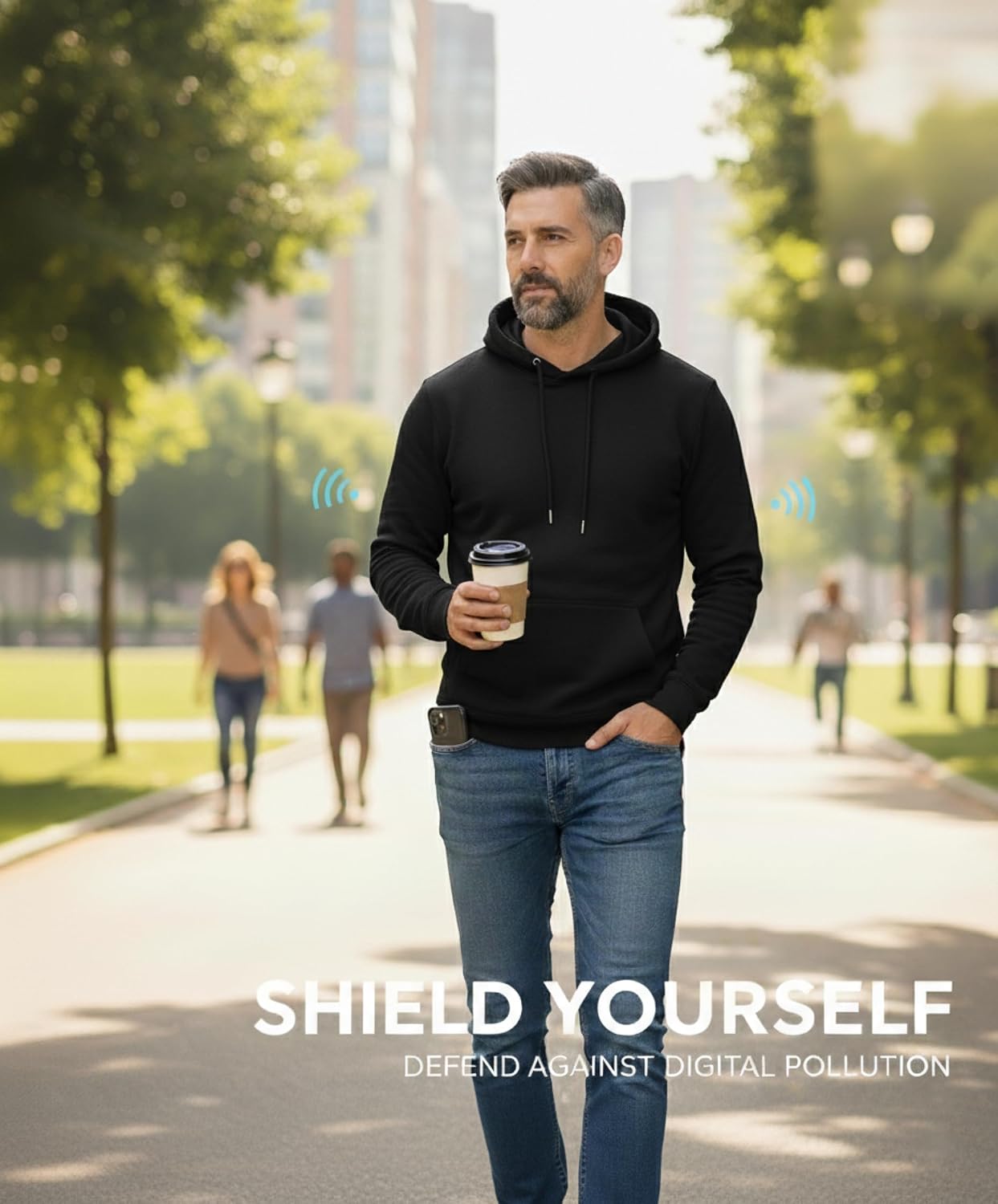
If you’ve ever seen an “EMF-blocking hoodie” in an online ad and wondered whether it’s a real technology or clever marketing, you’re not alone — and the answer is: it’s a real technology, but how well it works depends enormously on specifics that most product pages gloss over. EMF stands for electromagnetic field, the invisible energy radiated by wireless devices like phones, Wi-Fi routers, and laptop antennas. Some of that energy is absorbed by body tissue — a measure called SAR (Specific Absorption Rate), which the FCC tracks and publishes for every phone sold in the U.S. Silver fiber garments are designed to reflect and attenuate (reduce) that energy before it reaches the wearer’s body. This article walks through how that actually works, what the published decibel specs mean in plain English, and whether the $120–$180 price tag on leading brands is justified — or whether you’re mostly paying for branding.
| EDITOR'S PICK[DefenderShield EMF Radiation Pr…](https://www.amazon.com/dp/B0BLXX9RNR?tag=greenflower20-20) | Mid-tierEMF shielding full zip hoodie | Budget pickEMF Protection Poncho | |
|---|---|---|---|
| Material | Silver Fabric Lining | Double layer silver fabric | — |
| Style | Zip-up jacket | Full zip hoodie | Poncho / wrap |
| Size range | Large | Medium-Large | Large |
| Color | Gray | Grey | Black |
| Claimed shielding | — | Double radiation protection | Block EMF, RF, WiFi, Bluetooth |
| Price | $379.99 | $248.00 | $99.99 |
| See on Amazon → | See on Amazon → | See on Amazon → |
How Silver Fiber Fabric Actually Works
The core idea is straightforward. Pure silver is an excellent electrical conductor, which means it reflects electromagnetic waves rather than letting them pass through. When silver is spun into fine threads and woven into a fabric, the resulting textile creates a conductive mesh that acts like a partial Faraday cage — a Faraday cage being any conductive enclosure that blocks or reduces electromagnetic fields inside it. A solid metal box is a perfect Faraday cage; a woven fabric with small gaps between threads is a partial one.
The key variables that determine how well a silver fiber garment performs are:
- Silver content by weight — typically expressed as a percentage or grams per square meter (g/m²). Higher silver content generally means better conductivity and attenuation, but also higher cost.
- Weave density — tighter weaves leave smaller gaps, which matters more at higher frequencies. A fabric that blocks well at 900 MHz (older cell signals) may leak more at 5 GHz (Wi-Fi) or millimeter-wave 5G (24–40 GHz).
- Frequency range tested — this is where most product pages get evasive. A published dB spec is only meaningful when paired with the frequency at which it was measured.
LessEMF.com’s technical fabric documentation, one of the more transparent resources in this space, notes that silver-fiber fabrics typically show attenuation in the range of 20 dB to 50 dB depending on weave, frequency, and silver percentage — with performance degrading at higher frequencies. For reference, 20 dB means the fabric is reducing the transmitted signal to roughly 1% of its original power (a 99% reduction), and 30 dB reduces it to 0.1%. These are significant numbers — but they assume the fabric is properly oriented, covers the relevant body area completely, and hasn’t been degraded by washing.
What Published dB Specs Are Telling You (and What They’re Not)
Here’s where the comparison-shopping gets complicated. Not all published dB specs are created equal, and the number on the box may not reflect real-world performance.
The frequency problem. A garment rated at 35 dB attenuation sounds impressive — until you notice the test was conducted at 1 GHz, which is the sweet spot for most woven silver fabrics. The same garment may deliver 15–20 dB at 5 GHz Wi-Fi frequencies and potentially less at 28 GHz millimeter-wave 5G. Lambs, one of the most spec-transparent brands in this category, publishes attenuation data across multiple frequency bands in their product datasheets, which is the standard you should hold every other brand to.
The certification problem. Independent lab certification means the published spec was verified by a third-party testing facility using standardized methods — not just measured in-house. Look for references to MIL-STD-285 (a U.S. military shielding standard), IEEE 299, or testing against ICNIRP frequency guidelines. The Building Biology Institute’s Standard of Building Biology Testing Methods (SBM-2015) is another framework that practitioners in this space reference. If a product page shows no testing protocol and no certifying lab name, the dB number is unverified marketing copy.
The coverage problem. A hoodie covers the torso, arms, and sometimes the head — but not the legs, face, or hands. This matters if you’re wearing the garment specifically for phone or laptop use at your desk. A 40 dB garment covering 60% of your body is doing less total work than the spec implies.
By the Numbers
| Attenuation (dB) | Power Reduction | What It Means in Practice |
|---|---|---|
| 20 dB | 99% | Good baseline for casual daily wear |
| 30 dB | 99.9% | Standard for dedicated shielding garments |
| 40 dB | 99.99% | High-performance; verify the test frequency |
| 50 dB | 99.999% | Exceptional; rare in wearables, more common in purpose-built Faraday enclosures |
Breaking Down the $120–$180 Price Tag
Lambs is the most visible brand at this price point, and their pricing is a useful benchmark. As of May 2026, their EMF-blocking hoodies typically land in the $120–$160 range depending on the style. DefenderShield also offers EMF-protective apparel, though they’re more widely known for their laptop shields and device cases. What exactly are you paying for at this tier?
Silver content and fabric quality. Industrial silver fiber used in medical and shielding applications is expensive. A garment with meaningful silver content — enough to produce real attenuation — costs significantly more to manufacture than conventional sportswear. This is the legitimate cost driver.
Design and wearability. At $120–$180, brands are competing with premium athletic and lifestyle wear on aesthetics, fit, and feel. The silver-fiber construction can make cheaper garments feel slightly stiffer or cooler against the skin; higher-end brands invest in blending the conductive fiber with cotton, modal, or merino to improve drape and comfort. Owners across aggregated reviews consistently mention that Lambs garments feel like standard premium hoodies rather than industrial protective gear — which is the point.
Brand certification and transparency overhead. Paying for lab certifications and maintaining updated datasheets is genuinely costly. The brands that publish credible specs have invested in that infrastructure, and it’s built into the price. You are, to some degree, paying for the documentation — which is reasonable if the documentation is what gives you confidence in the product.
What you’re not necessarily getting: A hermetic shield. Even the best woven silver-fiber garment is not a Faraday bag. It attenuates rather than blocks, and the real-world performance depends on fit, frequency, and usage pattern. Scientific American’s 2023 reporting on EMF exposure notes that the evidence base for health effects from consumer-level EMF exposure remains mixed and actively researched — the FCC and ICNIRP maintain exposure guidelines that most consumer devices already comply with. That context doesn’t invalidate shielding garments for people who want additional precaution, but it’s the honest framing.
Who Each Tier Is Actually For
Budget silver-fiber garments ($30–$80, often from specialty suppliers like LessEMF): These are functional if the spec sheet is available and the test frequency is disclosed. They typically sacrifice design and comfort for raw material cost savings. If you’re a building biology consultant buying fabric by the yard for client retrofits, this tier makes sense. If you’re a consumer who wants to wear it daily, the wearability gap versus premium brands is real.
Mid-tier branded garments ($80–$120): The emerging category. A few brands are entering this space with reasonable specs and more honest marketing. Verify the frequency range tested and the certifying lab before buying. Owners in longer-run reviews note that wash durability at this price point is inconsistent — silver fiber can lose conductivity with repeated washing if not handled correctly (hand wash or delicate cycle in cold water is the standard recommendation across nearly all manufacturers).
Premium garments ($120–$180, e.g., Lambs): The right choice if wearability matters and you want the most transparent spec documentation in the category. The attenuation numbers are published per band, the design is genuinely competitive with regular premium sportswear, and the brand has invested in maintaining a credible certification paper trail. Reviewers consistently rate the fit and fabric quality as the primary differentiator from cheaper alternatives.
Expectant parents specifically: If you’re in this segment, DefenderShield’s belly bands and Silver Shield maternity garments are the more targeted product category — a hoodie leaves the abdominal area partially uncovered depending on fit. Dedicated maternity shielding garments are designed to maintain consistent coverage over the areas of primary concern. The same spec-verification framework applies: ask for the dB rating, the test frequency, and the certifying lab.
The Decision Rule
If you’ve read this far and are trying to make a call, here’s the honest if/then framework:
If wearability and daily use are the priority — and you want a garment you’ll actually wear for more than a week — spend the $120–$160 for a premium brand with published multi-band specs and independent certification. The LessEMF technical fabric documentation and Lambs’ product datasheets are the two most useful documents to compare directly before buying.
If you’re sourcing fabric for a professional application (nursery retrofit, building biology consultation, bulk garment construction) — buy by the yard from a specialist supplier, verify the g/m² silver content and attenuation spec at your relevant frequency, and factor in wash durability for the end use.
If a product has no published dB spec or no named certifying lab — pass, regardless of price. The transparency bar in this category is clear enough that an absence of data is itself a data point.
If the main frequency of concern is 5 GHz or higher (modern Wi-Fi, newer 5G bands) — specifically ask for attenuation data at those frequencies, not just at 900 MHz or 1 GHz. A 35 dB spec at 1 GHz from a garment that hasn’t been tested at 5 GHz is not a 35 dB guarantee across your actual device ecosystem.
The silver fiber technology is real, the physics is sound, and the leading brands are producing garments that genuinely attenuate EMF across meaningful frequency ranges. What you’re paying for at the premium tier is the combination of verified performance, wearable design, and the documentation trail that lets you actually trust the number on the box. That’s a reasonable value proposition — as long as you hold every brand to the same standard of proof before you buy.